
Kenosha County Court Records After a Jail Arrest
After a Kenosha County arrest, the booking record and the criminal court record do not come from the same office. The Sheriff's Office Detentions Division handles jail custody, intake, classification, housing, transport, and roster support. The prosecutor's office decides what charges to file in court. The Kenosha County District Attorney is described by the county as the gatekeeper to the criminal justice system, with duties set by Wis. Stat. 978.05. That prosecutor-filed case is the record that later shows charge status, hearings, disposition, sentencing, and warrants when those items are entered in court.
Use jail inmate records when the question is whether a person is currently in county custody, which facility houses the person, or whether a booking record exists in the current or archive inmate search. Use jail mugshots when the question is whether a booking photo can be found or requested. Use court records after a jail arrest when the question is what criminal case was filed, which charges remain active, whether bond conditions were set, and how the case ended.
Kenosha County's court side has several local anchors. The District Attorney's Office is in the Molinaro Building at 912 56th Street in Kenosha and can be reached at 262-653-2400. The Clerk of Circuit Court is also at 912 56th Street, phone 262-653-2664, with courthouse hours Monday through Friday, 8 a.m. to 5 p.m. The county's Court Case Tracker directs users to Wisconsin Circuit Court Access, commonly called WCCA, and explains that once a case is found, an RSS button can be used to request automatic feeds for case updates.
How to Find Court Records After an Arrest
The usual search path begins with custody context, then moves to the court portal. Start with the county inmate search if the person may still be in the jail system. Then check WCCA for the prosecutor-filed case. If the case is too new, the court record may not be visible yet. If the arrest did not result in filed charges, WCCA may not show a criminal case. If the case is municipal, federal, juvenile, sealed, or handled outside Kenosha County Circuit Court, the statewide circuit-court search may not answer every question.
- Open the Kenosha County Court Case Tracker or the Wisconsin Court System case-search page, then continue to WCCA for circuit court cases.
- Search by defendant name or exact case number. For common names, narrow by Kenosha County and use middle initial, age context, or filing date when available.
- Open the case summary and compare the charge list to the booking information. Filed charges can differ from the arrest-facing charge language on a jail record.
- Review each charge's status, court dates, events, warrants, disposition, sentence, and bond entries if those items appear in the case record.
- For paper copies, older files, or documents that are not visible online, contact the Kenosha County Clerk of Circuit Court rather than relying only on the web summary.
The Wisconsin Court System case-search landing page is the statewide starting point for public access to Wisconsin court records, including circuit court records and appellate searches. The WCCA portal is the practical lookup tool for Kenosha County criminal cases after prosecutors file them.
The Wisconsin Court System maintains the case-search landing page that routes users to circuit and appellate court records.
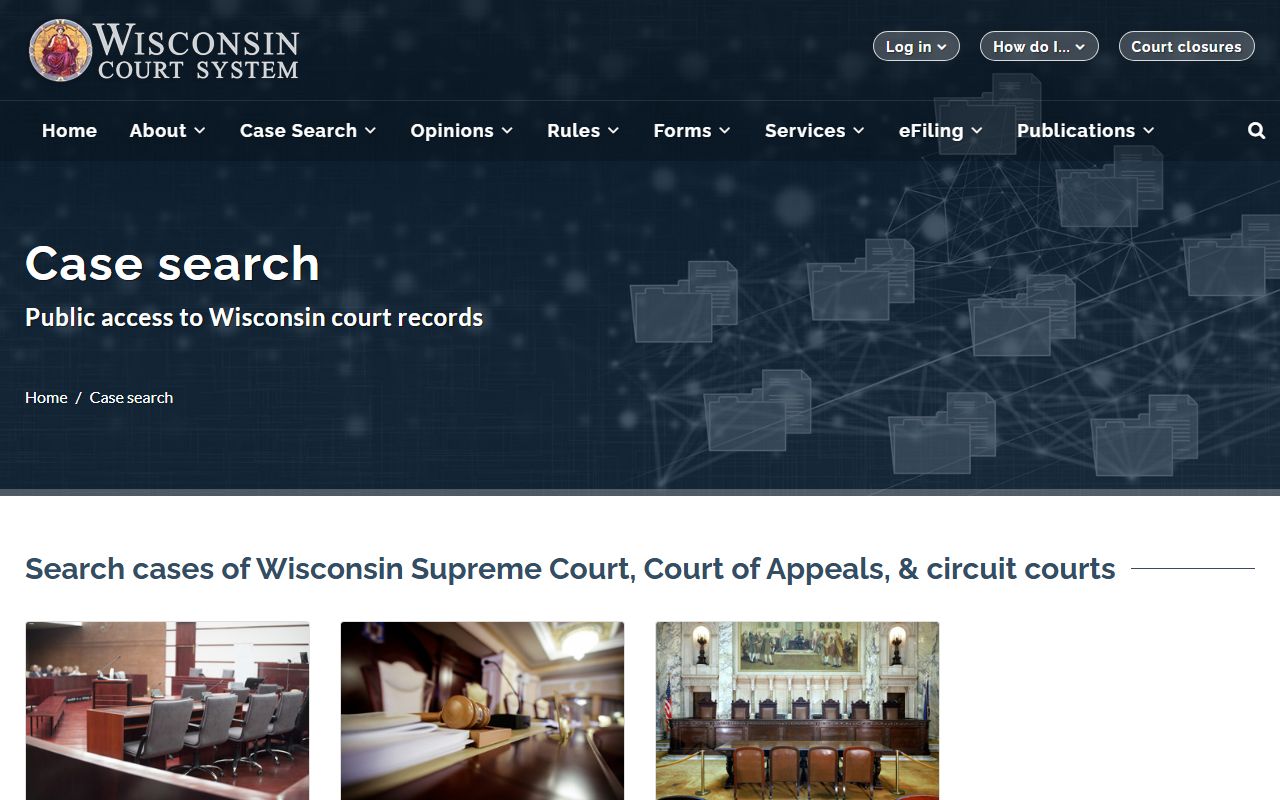
That statewide page is useful because it separates court records from jail custody records and points searchers toward the correct court system.
WCCA Fields for Kenosha Court Records
WCCA's live form is dynamic, and the research pass did not capture every control in a text browser. The supported court-search fields below come from the Wisconsin court-search source and Kenosha County's Court Case Tracker directions. The table is most useful when a person was recently booked at the Pre-Trial Facility or Kenosha County Detention Center and the searcher needs to know whether the arrest has become a filed criminal case.
| Field | Use | Kenosha Notes |
|---|---|---|
| Case number | Searches a specific Wisconsin circuit court case when the exact number is known. | Best for copy requests and follow-up after a first WCCA match. |
| Party name | Searches by defendant or other party name. | Common names need county, date, and middle-initial context. |
| County | Narrows results to a county court. | Choose Kenosha County for a local arrest and prosecution when the filter is available. |
| Case type | Limits the search by criminal, forfeiture, traffic, civil, family, or other categories. | Traffic and forfeiture matters may look different from criminal complaints. |
| Filing date or date range | Limits results by filing period if the portal exposes that control. | Useful when the arrest date is known but the case number is not. |
Wisconsin Circuit Court Access is available through the WCCA portal and is the primary public lookup point for filed circuit court case records.
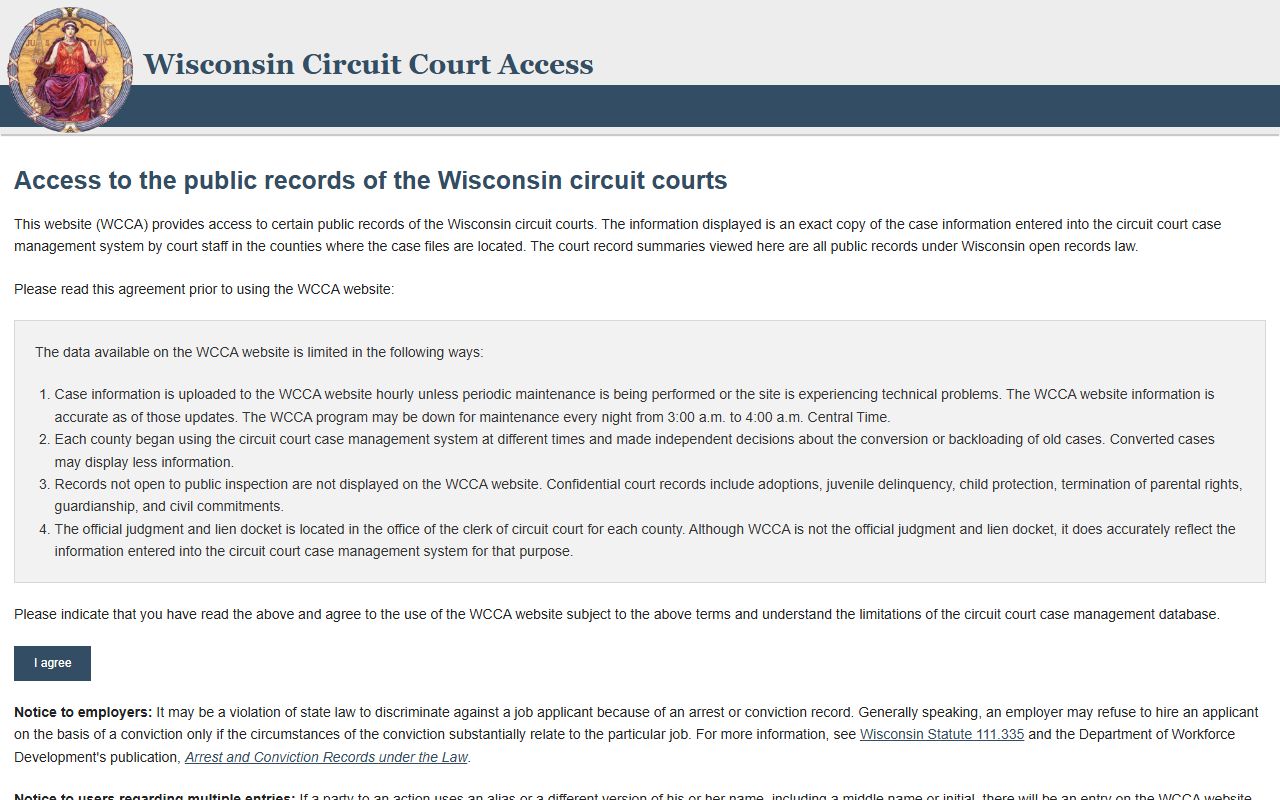
If a WCCA search does not locate a case, check spelling and county filters first, then consider timing, municipal court, federal custody, sealed records, or a decision not to file charges.
Charging Documents After an Arrest
The arrest and booking event begins custody processing, but the court case begins through a charging document. In Kenosha County, the District Attorney's Office handles criminal prosecution for violations of state and county law, including criminal offenses, juvenile delinquencies, traffic violations, county ordinance matters, and other categories listed by the office. A complaint is the most familiar starting point for many criminal cases. Information and indictment are also formal charging paths depending on the case and procedure.
| Document | Who Files or Creates It | What It Does | Why It Matters After Booking |
|---|---|---|---|
| Complaint | Usually filed by the prosecutor based on law-enforcement reports and probable cause. | Starts many criminal cases and states the charges being alleged. | Often explains why the court case now exists after a jail arrest. |
| Information | Filed by the prosecutor in the court process. | Sets out formal charges after earlier proceedings in qualifying cases. | Can refine what began as an arrest or complaint charge. |
| Indictment | Returned through a grand-jury process where used. | Formally accuses a person of an offense through that procedure. | Less common in ordinary local lookups, but still a charging-document category. |
The Kenosha County District Attorney page identifies the office's prosecuting role, statutory duties, and local contact information.
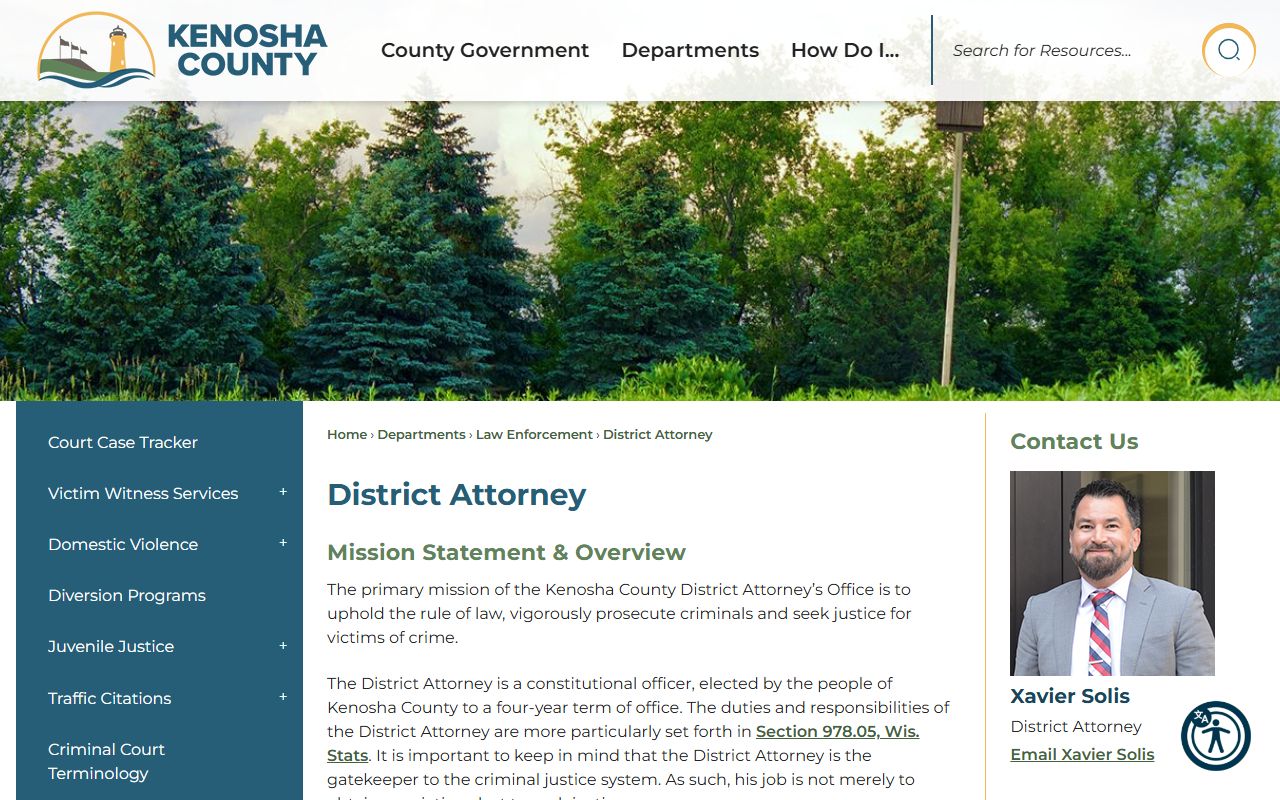
Because the prosecutor's filing controls the court record, do not treat a booking charge as the final legal outcome.
Charge Status in Court Records After Arrest
Charges can change as a Kenosha County case moves through court. The jail roster may show arrest-facing or booking-facing language, while WCCA is better for the formal filed charges and how the court disposed of them. A person can be booked on one description, charged under a different count, see a charge amended, or have one count dismissed while another remains pending. The court record is the place to track that change over time.
| Status | What It Means | How to Read It |
|---|---|---|
| Pending | The charge has been filed and has not been resolved. | Check future hearing dates, bond conditions, and recent events. |
| Amended | The charge was changed from the original filing. | Compare the original count to the current count before summarizing the case. |
| Reduced | The charge was lowered to a lesser offense through charging decision, negotiation, or court action. | Do not describe the original higher charge as the final result. |
| Dismissed | The charge ended as to that count by court or prosecutor action. | Check whether other counts remain active in the same case. |
| Conviction | The case or count reached a final adjudication through plea, verdict, or other qualifying outcome. | Read the disposition and sentence fields, not just the charge title. |
Bond and Release After an Arrest
Bond after a Kenosha County arrest is handled through the court process, not through the inmate-account deposit kiosk. The county's lobby kiosk page states that the kiosk cannot be used for posting bond. Bond must be posted at Joint Services in the Public Safety Building at 1000 55th Street. Before traveling, confirm the amount, case number, hours, and accepted payment method because the research did not locate a current official fee or payment-method table.
| Release Situation | What It Means | Where to Verify |
|---|---|---|
| Cash bond | A money amount must be posted if the court allows release on that basis. | Check WCCA and confirm with the appropriate court or Joint Services. |
| Recognizance bond | The person may be released on a promise to appear, often with conditions. | Read the court's bond conditions and hearing entries. |
| No-bond hold | Payment alone will not release the person. | Review the court entry and call the jail if custody status is unclear. |
| Other-agency hold | Another county, probation/parole, U.S. Marshals, or immigration authority may affect release. | Use WCCA for the local case and the proper outside-agency channel for the hold. |
Federal pretrial detainees may be physically held in the Kenosha County jail system under U.S. Marshals authority. That does not make the case a normal Kenosha County Circuit Court case, and it does not mean the Bureau of Prisons locator will list the person as a sentenced federal inmate.
Warrants That Lead to an Arrest
No official Kenosha County active-warrant search page was found in the research. For court records after a jail arrest involving a warrant, use WCCA first to look for case events, warrant status, and failure-to-appear entries. The Clerk of Circuit Court can route questions about court files. The Sheriff's Office main number is 262-605-5100, and non-emergency dispatch is 262-656-1234. Civil Process at 262-605-5104 handles civil papers, not a public criminal warrant database.
A warrant can lead to booking at the Pre-Trial Facility or another custody step. An arrest warrant authorizes arrest. A bench warrant is often issued by a judge after failure to appear or violation of a court order. A search warrant authorizes a search and is not the same as an arrest warrant. A fugitive warrant or hold may involve another jurisdiction. If a person is arrested on a warrant, bond may depend on the issuing court and any other holds.
Charges vs. Convictions
An arrest is not a conviction, and a filed charge is still an accusation unless and until the court reaches a qualifying final outcome. This distinction matters for Kenosha County court records because a single case can contain dismissed counts, amended counts, pending counts, and convictions. Reading only the charge title can make a case look more final than it is.
| Question | Charge | Conviction |
|---|---|---|
| Stage | Filed accusation after arrest and review by prosecutors. | Final adjudication by plea, verdict, or other court outcome. |
| Proof level | Based on charging standards and probable-cause concepts. | Requires the legal standard needed for conviction. |
| Where it appears | WCCA charge list, complaint, information, or other filings. | Disposition, judgment, sentence, and related court entries. |
| How it can change | May be amended, reduced, dismissed, or replaced. | May later be affected by appeal, postconviction relief, or expunction where allowed. |
Sealed vs. Expunged Arrest Records
Wisconsin public records law begins with a presumption of access, but public access is not unlimited. Wis. Stat. 19.31 and 19.35 support inspection and copies unless another law limits release. Juvenile records, sealed matters, law-enforcement investigation concerns, medical details, safety issues, and privacy limits can narrow what is available. Wisconsin expunction is addressed by Wis. Stat. 973.015 for qualifying cases, and it is different from merely asking a website to remove a search result.
| Issue | Sealed | Expunged |
|---|---|---|
| Public visibility | Access is restricted from normal public view by court rule or order. | The qualifying court record is removed from public access as allowed by Wisconsin law. |
| Legal basis | Depends on record type, order, juvenile status, or other confidentiality rule. | Depends on eligibility and the statutory requirements for the case. |
| Effect on jail records | Does not automatically prove that every custody record disappears. | May require separate follow-up with the agency that holds a related record. |
| Kenosha inmate-search removal | Not the same as sealing a court file. | The county removal page requires proof from the Wisconsin Crime Information Bureau that fingerprints for the arrest were removed from the Wisconsin Criminal History Repository before the Sheriff's Department considers removing the public inmate-search record. |
Clerk Copies and Court File Questions
WCCA is a search index and case-summary tool, not a complete substitute for the court file. When a document is missing online, when an older case needs review, or when a certified copy is needed, contact the Kenosha County Clerk of Circuit Court. The Clerk's page lists the office at 912 56th Street, Kenosha, WI 53140, phone 262-653-2664, and courthouse hours Monday through Friday, 8 a.m. to 5 p.m., with holiday closures posted by the county.
The Kenosha County Clerk of Circuit Court page provides the local court-record office, courthouse hours, phone number, and a WCCA quick link.
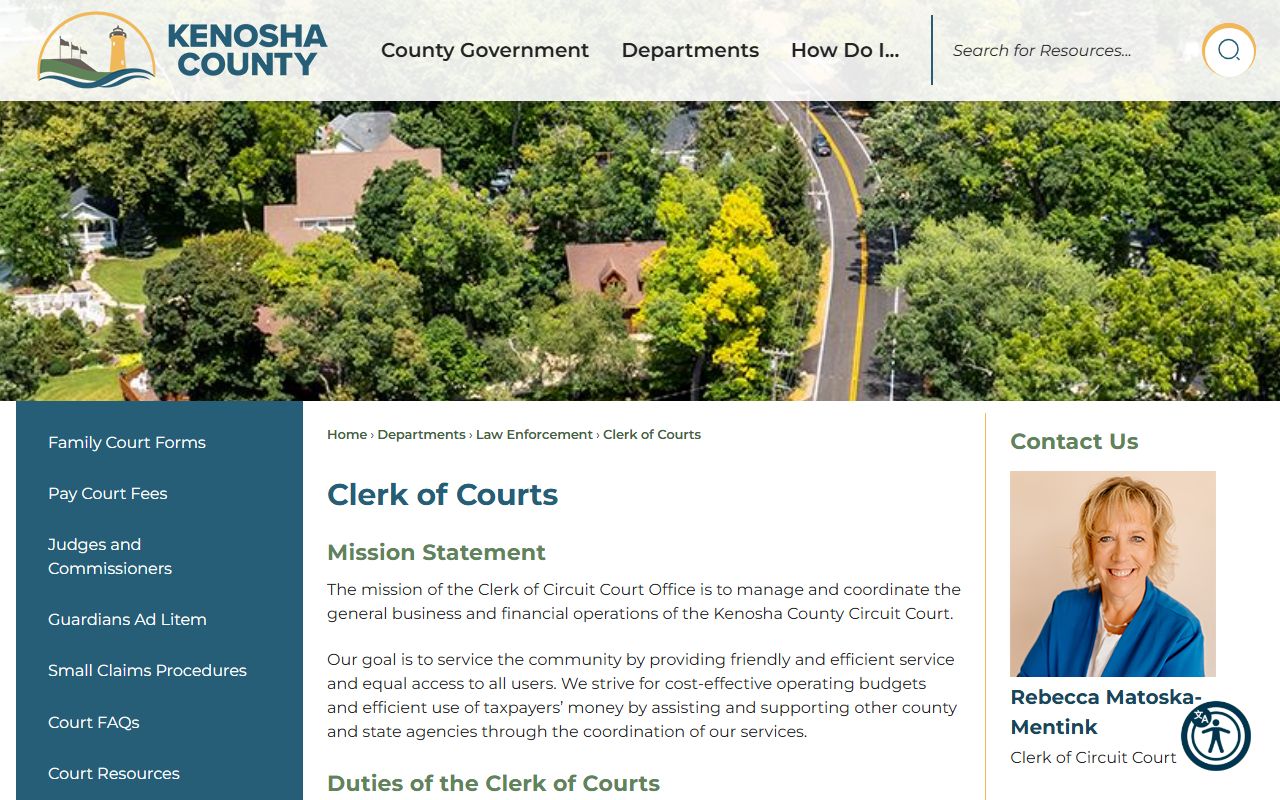
For a focused copy request, include the defendant name, case number if known, arrest or filing date, document name, and whether a certified copy is needed.
Background Check Considerations
Casual court-record lookup is not the same as a regulated background check. Kenosha County court records can help a person understand public case history, but they should not be used for employment, credit, housing, insurance, tenant screening, or another decision covered by the Fair Credit Reporting Act. A court summary may also be incomplete if the case is sealed, recently filed, amended, or resolved in a way that requires careful reading.
Important: Public court-record lookup is not a consumer report and must not be used for FCRA-covered decisions.
Restricted Court Records After an Arrest in Kenosha County
Some records tied to a Kenosha County arrest may be public, while others may be limited or unavailable. Juvenile matters are not treated like ordinary adult criminal cases. Ongoing investigation records may be withheld or redacted. Jail records can involve security, medical, classification, or safety concerns. Court records may be sealed or restricted by statute, court order, or case type. When a record is not visible online, the better next step is a targeted request to the office that created the record, not a guess based on a third-party database.
For custody details, use the county inmate-search path or the jail lines. For filed charges, use WCCA and the Clerk. For prosecution context, use the District Attorney's Office. For sentenced state prison custody, use Wisconsin DOC, and for sentenced federal custody, use BOP. Keeping those systems separate prevents the most common mistake after an arrest: treating jail custody, court charges, and final conviction status as one record.
Public Record Search
Sponsored Results